• The new WDWMAGIC iOS app is here!
    Stay up to date with the latest Disney news, photos, and discussions right from your iPhone. The app is free to download and gives you quick access to news articles, forums, photo galleries, park hours, weather and Lightning Lane pricing. Learn More
  • Welcome to the WDWMAGIC.COM Forums!
    Please take a look around, and feel free to sign up and join the community.

News Disney World Earmarks 80 Acres for Affordable Housing

MisterPenguin

President of Animal Kingdom
Premium Member
There definitely is a lot of that playing into feelings on this development. However, there are legitimate concerns about the lack of infrastructure available in the area, without plans for remediation.

Water Spring Elementary, a nearby elementary school finished the last academic year significantly overcapacity, operating at 148% capacity. Nearby Horizon High School, which this new development will likely be zoned for, is also operating over capacity.

Besides the academic infrastructure, the road infrastructure in the area is inadequate, without plans to add more infrastructure. Public transportation in the area is non-existent as well, forcing these residents to rely on a personal vehicle for transportation. While it may be common for new developments to have inadequate transportation infrastructure upon being built, the lack of plans for future expansions is concerning.


On the other hand…

Having Flamingo Crossings nearby is nice, and assuming a sidewalk is eventually built connecting the two, there will be pedestrian access to the small Target and other stores located there. Cell service is rough, but it keeps getting better and should theoretically meet demand eventually. Road infrastructure will almost certainly be improved upon eventually, but it is concerning the lack of planning that has been done thus far.

To me, if there were clear plans for alleviating the academic and transportation infrastructure in the area, this would be a much more palatable addition to the area. It’s hard to stomach something like this when you have legitimate concerns over the infrastructure in the area of the development in addition to the usual NIMBY sentiment.
And where do we find this fantastical land on which to build low income / denser housing which already has a surplus of infrastructure that does not require more or wider roads, or more classrooms, or more demand on utilities?
 

lazyboy97o

Well-Known Member
However, there are legitimate concerns about the lack of infrastructure available in the area, without plans for remediation.
They are not legitimate concerns. They are intentional choices made to create such concerns.

Tear out the massive car staging areas at the schools and build more classrooms. Boom. Two birds, one stone to help the situation.
 

nickys

Premium Member
There is also way too much housing that is still unoccupied right there across the street and going up at Seidel. These properties are empty because the costs are too high. They should stop development until the unoccupied units meet a certain amount of occupancy.
Do you not see the contradiction in your argument?

Now I have no idea if the “authorities” have the power to force the developers of the high priced properties to lower their prices. But unless that happens, it seems like more affordable housing is needed.

As for the schools, if they really are operating at 50% over capacity, surely there must be plans to either expand or build new schools?
 

lazyboy97o

Well-Known Member
As for the schools, if they really are operating at 50% over capacity, surely there must be plans to either expand or build new schools?
Central Florida is actually better than some areas when it comes to maintaining school capacity. Large developers often have to pay to support school expansion and large developments even end up having to build new schools. Disney has now built three schools to support continued development of Celebration, with the newest opening just a few years ago. Being “overcapacity” is often a bit of a misnomer as it means the school has expanded as designed, but is using pre-manufactured classrooms (“trailers”).

The way the schools are laid out, typically as simple rectangles, means expanding the buildings wouldn’t actually be difficult. The challenge for a lot of them is the same root issue with so much development in the US, the primacy of the automobile. Almost everything is designed around the convenience of the car. Go pull up an aerial of Water Spring Elementary and you’ll see a loop road to the west of the school building. That big chunk of space’s sole purpose is for cars to sit and idle waiting for pickup in the afternoon. You will almost certainly find people sitting, burning gas nearly an hour before school lets out. Water Spring’s is actually a bit modest in size. That’s a plot of land that could easily hold an expansion of the school building but instead expansion will mean a demand for even more space for cars to sit and idle.

Water Spring Elementary’s next door neighbors is Water Spring Middle School. While there are some combined elementary and middle schools, these two schools are considered separate and therefore were designed as though they have no relation to each other. Despite the schools having different start and end times each one must serve the automobile fully. There is no shared space. Separate parking lots and buss loops, completely with their own separate access not even something like shared athletic fields. And of course expansion of either means more parking, constraining the ability to expand.

Intentional design choices limit the ability of the schools to more easily and cost effectively expand. That’s not an oversight or mistake. It’s a known outcome and it’s okay because nobody really wants the schools to expand too much anyway. They were built to support the single family homes and impeding density is a positive. Same with the very layout of these developments, all dead ends feeding to only a few roads creating traffic. Hinders the ability to provide transit or walkability, requiring ownership of an expensive car even if cheaper housing were available. Also creates the very traffic people use to argue against other developments. The layout also increases infrastructure costs which naturally hinders certain types of developments.
 

nickys

Premium Member
Central Florida is actually better than some areas when it comes to maintaining school capacity. Large developers often have to pay to support school expansion and large developments even end up having to build new schools. Disney has now built three schools to support continued development of Celebration, with the newest opening just a few years ago. Being “overcapacity” is often a bit of a misnomer as it means the school has expanded as designed, but is using pre-manufactured classrooms (“trailers”).

The way the schools are laid out, typically as simple rectangles, means expanding the buildings wouldn’t actually be difficult. The challenge for a lot of them is the same root issue with so much development in the US, the primacy of the automobile. Almost everything is designed around the convenience of the car. Go pull up an aerial of Water Spring Elementary and you’ll see a loop road to the west of the school building. That big chunk of space’s sole purpose is for cars to sit and idle waiting for pickup in the afternoon. You will almost certainly find people sitting, burning gas nearly an hour before school lets out. Water Spring’s is actually a bit modest in size. That’s a plot of land that could easily hold an expansion of the school building but instead expansion will mean a demand for even more space for cars to sit and idle.

Water Spring Elementary’s next door neighbors is Water Spring Middle School. While there are some combined elementary and middle schools, these two schools are considered separate and therefore were designed as though they have no relation to each other. Despite the schools having different start and end times each one must serve the automobile fully. There is no shared space. Separate parking lots and buss loops, completely with their own separate access not even something like shared athletic fields. And of course expansion of either means more parking, constraining the ability to expand.

Intentional design choices limit the ability of the schools to more easily and cost effectively expand. That’s not an oversight or mistake. It’s a known outcome and it’s okay because nobody really wants the schools to expand too much anyway. They were built to support the single family homes and impeding density is a positive. Same with the very layout of these developments, all dead ends feeding to only a few roads creating traffic. Hinders the ability to provide transit or walkability, requiring ownership of an expensive car even if cheaper housing were available. Also creates the very traffic people use to argue against other developments. The layout also increases infrastructure costs which naturally hinders certain types of developments.
Interesting.

But I thought almost everyone went to school on a bus in the US. So if that’s not the case, why not run more school buses and eliminate the need for cars and parking?
 

Ayla

Well-Known Member
Interesting.

But I thought almost everyone went to school on a bus in the US. So if that’s not the case, why not run more school buses and eliminate the need for cars and parking?
You think the staff is going to ride a bus to work? 😂
 

lazyboy97o

Well-Known Member
Interesting.

But I thought almost everyone went to school on a bus in the US. So if that’s not the case, why not run more school buses and eliminate the need for cars and parking?
It’s not an issue of insufficient buses. Parents are choosing to not have their kids ride the bus.

You think the staff is going to ride a bus to work? 😂
The parking lots are larger than required just for staff.
 

nickys

Premium Member
It’s not an issue of insufficient buses. Parents are choosing to not have their kids ride the bus.


The parking lots are larger than required just for staff.
Well in that case, reserve the staff parking (behind a barrier if necessary) and take away the extra parking.
Then designate no parking / idling zones within a mile of schools. That should persuade most parents to use the buses, or walk. Either way is a win! 😁
 

lazyboy97o

Well-Known Member
Well in that case, reserve the staff parking (behind a barrier if necessary) and take away the extra parking.
Then designate no parking / idling zones within a mile of schools. That should persuade most parents to use the buses, or walk. Either way is a win! 😁
Even with these massive lots and staging areas, you will also find people just parking in front of the schools to ditch the lines. Parking isn’t allowed in these places, but it’s not enforced at all. We bend of backwards and make things less safe for kids to make things more convenient for drivers.
 

Vegas Disney Fan

Well-Known Member
The NIMBYism could at least try for some originality.
NIMBYism doesn’t require originality, the reason for it is (usually) obvious.

People like to view this as a simple right or wrong issue but NIMBYism is often justified, no one wants their home (typically their largest asset) to lose value, no one wants their 20 minute commute to turn into a 40 minute commute, no one wants their kids classroom to go from 30 students to 40 students…

Do we need more housing, especially affordable housing? Absolutely!
Public transit? Yep! Social Services? Yep!, homeless shelters? Yep!, the list is endless… that doesn’t mean people don’t have a valid reason to be upset about change when it negatively impacts them though.

Every argument I’ve read so far seems justified, especially the schools one, it takes years, sometimes decades, for infrastructure to catch up. Most of us have probably experienced it firsthand, assuming you live in a growing area. My neighborhood has been trying to catch up for a decade, schools are still overcrowded, the grocery stores still run out of stuff, the lines at the pharmacy/restaurants keep getting longer, schools are using temporary classrooms, as soon as the infrastructure starts to catch up they announce the next massive new apartment complex or the next huge master planned community and it starts over again, it’s necessary but that doesn’t mean it’s not frustrating…

This forum isn’t all that different, we largely talk about the changes happening at Disney and whether we like them or not, in most cases you could probably argue they are 100% justified, that doesn’t mean we have to like them though and can’t miss the quieter, simpler times.
 

Disstevefan1

Well-Known Member
NIMBYism to me is ANY new housing that turns vast empty cattle farms into MASSIVE housing complexes even if they are high priced! I drive by these MASSIVE construction sites that were vast empty cattle farms; the grandkids of the late farmer just CASHED IN and sold all that land to the developers, and all I can think of is the TRAFFIC these MASSIVE complexes will create.

The traffic is already bad and its going to get worse.
 

lazyboy97o

Well-Known Member
NIMBYism doesn’t require originality, the reason for it is (usually) obvious.

People like to view this as a simple right or wrong issue but NIMBYism is often justified, no one wants their home (typically their largest asset) to lose value, no one wants their 20 minute commute to turn into a 40 minute commute, no one wants their kids classroom to go from 30 students to 40 students…

Do we need more housing, especially affordable housing? Absolutely!
Public transit? Yep! Social Services? Yep!, homeless shelters? Yep!, the list is endless… that doesn’t mean people don’t have a valid reason to be upset about change when it negatively impacts them though.

Every argument I’ve read so far seems justified, especially the schools one, it takes years, sometimes decades, for infrastructure to catch up. Most of us have probably experienced it firsthand, assuming you live in a growing area. My neighborhood has been trying to catch up for a decade, schools are still overcrowded, the grocery stores still run out of stuff, the lines at the pharmacy/restaurants keep getting longer, schools are using temporary classrooms, as soon as the infrastructure starts to catch up they announce the next massive new apartment complex or the next huge master planned community and it starts over again, it’s necessary but that doesn’t mean it’s not frustrating…

This forum isn’t all that different, we largely talk about the changes happening at Disney and whether we like them or not, in most cases you could probably argue they are 100% justified, that doesn’t mean we have to like them though and can’t miss the quieter, simpler times.
Again, the infrastructure doesn’t catch up because it was intentionally designed to not catch up. These aren’t unsolved problems, we just reject the solutions. Simple things like having grids instead of cul-de-sacs would help traffic and the ability to offer transit services. Schools can be sited and better designed with expansion in mind. Large developments can be required to do things like provide infrastructure and right-of-way for transit. Stop requiring places to provide enough parking for everyone and their extended family and friends to be able to park well in excess of what the place can fit inside. But we don’t want to and people absolutely lose their minds at any sort of suggestion otherwise. People would absolutely nuts if subdivisions couldn’t be a bunch of dead end roads whose maintenance gets foisted onto everyone else despite not actually serving the public.
 

Vegas Disney Fan

Well-Known Member
Again, the infrastructure doesn’t catch up because it was intentionally designed to not catch up. These aren’t unsolved problems, we just reject the solutions. Simple things like having grids instead of cul-de-sacs would help traffic and the ability to offer transit services. Schools can be sited and better designed with expansion in mind. Large developments can be required to do things like provide infrastructure and right-of-way for transit. Stop requiring places to provide enough parking for everyone and their extended family and friends to be able to park well in excess of what the place can fit inside. But we don’t want to and people absolutely lose their minds at any sort of suggestion otherwise. People would absolutely nuts if subdivisions couldn’t be a bunch of dead end roads whose maintenance gets foisted onto everyone else despite not actually serving the public.
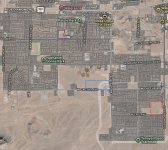
You basically described the Las Vegas area, massive grid system, developers are responsible for building the roads, providing land for the parks, expanding the utilities, setting aside land for the schools, etc… the problem is the housing always comes first, the developers need to sell the thousands of houses to pay for everything else and the city needs the property tax revenue first so they can afford to build the schools. It’s a never ending game of catch up.

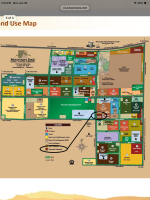
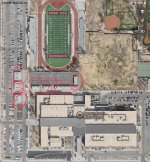
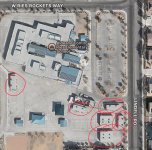
This is the community just west of mine, began about 20 years ago… the master plan from day 1 showed all the parks, schools, roads, etc… 20 years later and the big vacant spots of empty land are essentially all school lots, a few have been built but every spot I outlined is meant to be an elementary school, a middle school, or a high school. They’ll eventually get built, it just takes a lot of time. Meanwhile every school in my community has portable classrooms (circled in red) to accommodate those kids while they wait for the schools to be built in their community.

I’m not mad that they are building houses, we need them, but it’s insane to me the schools always seem to be the last thing built. That’s just how it works, the publicly funded spaces are always the last thing built because they don’t generate money, they cost a lot of money to build and it takes years of property taxes to generate enough to build them.

Can’t blame the developers, they are just providing desperately needed housing, can’t really blame the city either, they are building schools constantly, they just can’t keep up with the growth. I know people who say to just stop granting building permits but then we’re just going to have an even larger unaffordable housing problem. It’s a no win situation.

I’m not arguing right or wrong, just pointing out it’s 100% justified in my opinion for people to be frustrated with how the system works.

IMG_0573.pngIMG_0574.jpegIMG_0575.jpegIMG_0577.jpeg
 
Last edited:

davis_unoxx

Well-Known Member
We need more housing, but as someone who lived at Flamingo Crossing, the traffic is horrendous. Very common on may nights that it will take over 30 min to get from Coronado area to Flamingo Crossing due to backups on Western Way. From around 430 PM to as late as 11 PM. Avalon road is a two lane road to 192, and already has insane traffic.

They need to fix area around Flamingo Crossing so when gettin on 429 South you can enter from right side and have flyover ramp, instead of current setup where you have to yield to oncoming traffic while taking a left.

I've lived in Boston, LA and now Orlando. And honestly traffic here is so annoying. Back roads are so bad, my current apartment on Palm pkwy will be blocked in by traffic on a Saturday at noon.... Due to new entrance to I4 on Daryl Carter PKWY. We need more housing BUT WE NEED HIGHER CAPACITY ROADS FIRST
 

lazyboy97o

Well-Known Member
You basically described the Las Vegas area, massive grid system, developers are responsible for building the roads, providing land for the parks, expanding the utilities, setting aside land for the schools, etc… the problem is the housing always comes first, the developers need to sell the thousands of houses to pay for everything else and the city needs the property tax revenue first so they can afford to build the schools. It’s a never ending game of catch up.

This is the community just west of mine, began about 20 years ago… the master plan from day 1 showed all the parks, schools, roads, etc… 20 years later and the big vacant spots of empty land are essentially all school lots, a few have been built but every spot I outlined is meant to be an elementary school, a middle school, or a high school. They’ll eventually get built, it just takes a lot of time. Meanwhile every school in my community has portable classrooms (circled in red) to accommodate those kids while they wait for the schools to be built in their community.

I’m not mad that they are building houses, we need them, but it’s insane to me the schools always seem to be the last thing built. That’s just how it works, the publicly funded spaces are always the last thing built because they don’t generate money, they cost a lot of money to build and it takes years of property taxes to generate enough to build them.

Can’t blame the developers, they are just providing desperately needed housing, can’t really blame the city either, they are building schools constantly, they just can’t keep up with the growth. I know people who say to just stop granting building permits but then we’re just going to have an even larger unaffordable housing problem. It’s a no win situation.

I’m not arguing right or wrong, just pointing out it’s 100% justified in my opinion for people to be frustrated with how the system works.

View attachment 905083View attachment 905084View attachment 905085View attachment 905086

The system isn’t divine. It’s created by people and across the US it’s been created to deliver certain results. It’s been the status quo for so long that people assume it’s just how things are or are driven by market factors when in many cases they are driven by imposed regulation. People still love Main Street, USA and the small downtowns that inspired it, but across much of the country it’s illegal to build anything like it that isn’t a singular development, a mall.

The grid you show is a super grid. It’s a start but it still falls short. Each super block is still filled with single uses and dead ends. So the same problem arises that as more development occurs with the filling of a block, no new connections are created. And any sort of transit offering, which is really a key factor, is undesirable because there aren’t even pedestrian connections through the super blocks.

Amenities not being built is exacerbated by the same issue of doing everything at a larger, car oriented scale and singular uses. Instead of one large park it would be a lot easier to have smaller ones, with pedestrian access, in the super blocks. Same with other things like retail. This not only makes the costs easier to handle because they’re smaller, but also to hold developers accountable. Development of a super block can be tied to it having its own public amenities instead of the amenities being a very distinct, physically separate project. Even things like schools can be tied to development permission as is the case in Florida.

I don’t really get the hate towards pre-manufactured classrooms. For all intents and purposes they’re permanent buildings so they have to meet all of the same code requirements as the main building. But the screenshots you share both show design decisions that hinder the ability of the school to expand. The high school has a parking lot immediately to its west, which would be the natural place to expand the building. High school students do drive themselves so that’s not just space that easily be taken over. The elementary school is sited at an angle which also complicates its ability to expand.
 

lazyboy97o

Well-Known Member
We need more housing, but as someone who lived at Flamingo Crossing, the traffic is horrendous. Very common on may nights that it will take over 30 min to get from Coronado area to Flamingo Crossing due to backups on Western Way. From around 430 PM to as late as 11 PM. Avalon road is a two lane road to 192, and already has insane traffic.

They need to fix area around Flamingo Crossing so when gettin on 429 South you can enter from right side and have flyover ramp, instead of current setup where you have to yield to oncoming traffic while taking a left.

I've lived in Boston, LA and now Orlando. And honestly traffic here is so annoying. Back roads are so bad, my current apartment on Palm pkwy will be blocked in by traffic on a Saturday at noon.... Due to new entrance to I4 on Daryl Carter PKWY. We need more housing BUT WE NEED HIGHER CAPACITY ROADS FIRST
There’s seven decades of data that shows that higher capacity roads will not provide any relief. That’s even more the case when you orient everything around a few arterial roads.
 

HauntedPirate

Park nostalgist
Premium Member
I've always thought the problem was roads were designed for a certain point in time and a certain capacity, and planned for some additional capacity, but by the time plans are approved, funding provided, and construction is complete, they are already behind where they were when things started.
 

Vegas Disney Fan

Well-Known Member
That really doesn't happen. Usually vice versa...
If at all, I watch a lot of shows on YouTube on bike-able, walkable, transit centric communities and they (rightly in my opinion) always come to the conclusion we can’t build ourself out of road congestion because the more lanes we build the higher the induced demand, in many ways I think the same is true of housing, we like to think we can build our way out of high house prices but the more “affordable” houses we build the more people it encourages to move to an area, and the prices generally stay high.

Building 1,000 new affordable apartments for CMs sounds great but if those apartments end up going to transplants from (pick any state people leave for Orlando) who had previously decided against moving to Orlando due to high prices, but now decide to move because there’s “affordable” housing, then ultimately nothing changes.

Until a few years ago I dreamt of retiring in Orlando, as prices skyrocketed those plans changed, that’s likely true for thousands of people who wanted to move to Orlando, “lower” prices will encourage some of them to move again, which just maintains the housing shortage and the high prices.
 

lazyboy97o

Well-Known Member
I've always thought the problem was roads were designed for a certain point in time and a certain capacity, and planned for some additional capacity, but by the time plans are approved, funding provided, and construction is complete, they are already behind where they were when things started.
The issue is induced demand. Traffic is like a gas and fills available space. Adding lanes can also have diminishing returns because they can further slow movement.


Register on WDWMAGIC. This sidebar will go away, and you'll see fewer ads.

Back
Top Bottom