
-
The new WDWMAGIC iOS app is here!
Stay up to date with the latest Disney news, photos, and discussions right from your iPhone. The app is free to download and gives you quick access to news articles, forums, photo galleries, park hours, weather and Lightning Lane pricing. Learn More -
Welcome to the WDWMAGIC.COM Forums!
Please take a look around, and feel free to sign up and join the community.
You are using an out of date browser. It may not display this or other websites correctly.
You should upgrade or use an alternative browser.
You should upgrade or use an alternative browser.
News Josh D’Amaro Named Next CEO of The Walt Disney Company
- Thread starter DCBaker
- Start date

FettFan
Well-Known Member
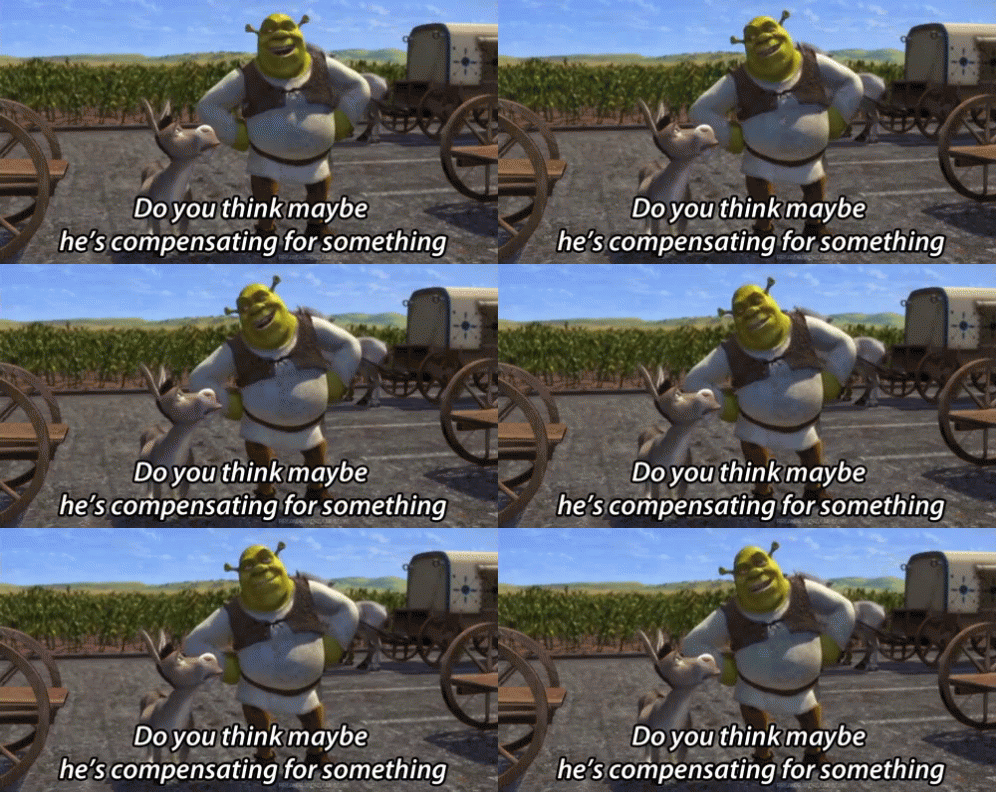
Bob always stands like he’s trying to reach a cookie on the top shelf. I’m guessing someone is trying to overcome a shortage?

Nubs70
Well-Known Member
Thanks to that thing created in 1986 called a 401k, more millionaires are made every day.The primary driver for that is people moving up, rather than down. So that really isn't a rebuttal for them pricing out the middle class.

JoeCamel
Well-Known Member
Ahh, but if everyone is a millionaire is anyone really a millionaire?Thanks to that thing created in 1986 called a 401k, more millionaires are made every day.

Chef Mickey
Well-Known Member
Execution is hard. I get tired of seeing the "X company didn't invent X so not a fan." There is no utility without execution. Apple didn't "invent" smartphones, touchscreens, or cell phones in general, but they executed in a way to package it up better than anyone in history.First of all I'm not a Tesla fan. Tesla didn't invent anything either, all of it existed before them. Companies were testing self driving features long before them, they just got to market first, but it was built on the back of others (DARPA even held competitions for the same features a decade before Tesla existed).
Just like streaming existed before Netflix too, ie they didn't invent it, it was built on the backs of others that came a decade before them.
Tesla is as much a software/data company as much as they are car manufacturer. Both are really hard. Building anything on a mass scale deserves tremendous respect.
Companies tried to test self-driving and it was trash. Same with phones.
Disney literally invents no technology but can create amazing attractions with creativity of using existing technology in interesting ways. They just don't anymore.
Last edited:
A study notated that 75% of luxury goods buyers are from the middle class. Clearly common sense 101 wasn’t taught in schools. If one wants to move up - Live life like no other so later you can live life like no other.The primary driver for that is people moving up, rather than down. So that really isn't a rebuttal for them pricing out the middle class.

flynnibus
Premium Member
No, at the time D+ did it, this is basically off the shelf, proven architectures. Disney just had to pay the bills to run it. When netflix was doing it, they were cutting edge trying to work out how to do this kind of stuff along with the titans like google.Disney didn't have the technological infrastructure in-house when they started either, so they had to overcome similar technological hurdles as well.
Yes, Disney literally just went out and paid for the catchup through acquisition.. instead of spending the years and $$ in R&D and technology evolution like the real innovators had to. Disney literally just wrote checks to get in the game... because it already existed.I like how some of you are making it seem like Disney just had all this stuff readily available to them to just plop up a streaming service overnight just because Netflix existed first. It took several years of building out capacity and acquisition of BAMTech in 2017 before they released Disney+ in 2019
In 2008 when streaming wasn't even their core business.. their profiles were only 83M per YEAR. They had to roll slow because they couldn't afford to just throw 5-10B at the problem like TWDC did..Netflix was also an established company that was already public before they even went into streaming, so they too also self financed through its existing business. They also weren't in the content creation business until later.
Note I said '[open] market'. They are doing cross-charging and people still need to get paid.. but that is nothing compared to having to compete for content in an open market.Disney also has to pay for their content, its not "free", they have to pay all involved through residuals and profit sharing (remember that strike a couple years ago where SAG was fighting for more of the pie), so its more expensive actually than just licensing (remember all those saying in the early days of D+ that Disney should just license out their content instead and make more money).
Last edited:
Chef Mickey
Well-Known Member
Tesla sells cars which are very expensive per unit. Saying they "made" $98B is misleading because that was just their sales revenue. Cars are expensive to make and relatively low margin. Tesla's profit is quite variable and actually decreasing as they lose subsidies. Electric cars are a terrible business unless you can make money on selling self driving (which is the goal).Cosmic Rewind - a single attraction at Epoct was estimated to have cost half a billion dollars. The Marvel flop, Eternals - just one movie Disney lost their a$$ on, cost almost $400 million to make and those examples are for an entertainment company that's held accountable for their spending. Let's not pretend a billion is even that much for a tech company raising capital in modern times.
And sorry but Tesla made almost $98 billion (with a *B*) in 2024. Saying they spent $500 million on charging stations (that are revenue generating in-and-of-themselves) is impressive to who?
Charging stations are basically glorified power plugs with a transformer, rectifier, and a POS system tied into an existing power grid, usually on land that’s already developed. I never said Ford built roads or gas stations but they single-handidly standardised a form of fuel and were responsible for mass adption which is how nationwide paved roads and a network of gas stations to take anyone with a car across them (Including Teslas) became possible. That’s why I never said Ford built the gas stations or the roads. Those were built to support the industry Ford created.
I kept it brief by saying highways and gas stations were created to support the vehicles Ford ushered in but we could just as easily talk about the entire system that had to emerge behind them. Fuel had to be distributed to those stations which required processing plants that didn’t exist in meaningful numbers at the time. That demand is what created most of the modern oil industry as we know it today.
To put this in context, the first Model T rolled out in 1908. Diesel trains didn’t even start appearing until around 1920, and steam engines remained dominant into the mid-1940s. The same infrastructure built around the Model T is what went on to support the fule for modern trains.
But yeah, I suppose you can call Telsa's fancy power plugs "infrastructure" in the same way a water refull jug station in the front of a Walmart that pulls water from the same place the facuets and toilets on the other side of thw wall uses is.
Either way, very impressive from the guy that said he'd have humans starting to colonize Mars by late 2020.
As for your “gotcha” comment, tell me again how my analogy is fawed?
Netflix didn’t invent streaming or smart TVs, and they don’t manufacture them—but Netflix was the service Roku’s first streaming device was designed for. That, along with advanced DVD players built to support Netflix streaming is what moved streaming from PCs to TVs. That shift eventually led to smart TVs and smartphone apps—all of which were common more than a decade before Disney+ launched.
Similarly, when the Model T first rolled off the assembly line, there weren’t gas stations on every corner or smooth roads everywhere, and you couldn’t just hook a car up to some existing “trickle” gas outlet. Before Ford, there was no fuel supply used commonly enough to justify that investment in the vast majority of America (or really, the world). Ford created the market that made it inevitable. Cars weren’t piggybacking on preexisting nationwide infrastructure unless you want to count the trains responsible for transporting the steel from Ohio used to make them.
Ford didn’t invent the car but let’s not pretend the modern highway system fuel stations, towns, and what we conceive of as the modern parking lots that house Tesla charging stations in gas stations and shopping centers were built to support the Ware Steam Wagon.
Until 2010, the longest video you could upload to Youtube was 10 minutes (it got bummed all the way to 15 minutes that year). Back in 2007 when Netflix premiered with the ability to stream full-length movies, what Youtube could handle was about 5 minutes. Prior to that, the typical length of a Youtube video was between 30 seconds and a minute.
Real Networks was primarily known for their software for streaming and not their own hosting of content. It was low resolution, low bitrate, web-only (with proprietary plugin), and frequently crashed browsers on under powered consumer computers of the day. I know this firsthand as someone who worked with RMVB back in the day.
As you pointed out, Ford wasn’t the absolute technical first—and in much the same way, Netflix didn’t invent streaming. What Netflix did do was turn streaming into something more than a PC novelty. Their innovation was making it viable at mass-market scale and in so doing, sparked an entire hardware ecosystem built to support first them. None of the early devices that moved streaming from a PC-only niche into the living room were designed for YouTube or RealNetworks. Real never gained meaningful support, and YouTube didn’t see serious hardware backing until years later.
They figured out how to deliver broadcast-quality (and later HD) streaming at near-infinite lengths without constant buffering. They secured licensing deals with traditional media companies to offer content consumers were willing to pay for, partnered with third parties like Roku and Sony to build low-cost, low-power devices designed specifically for TV playback and negotiated some of the earliest traffic-optimization agreements with major US ISPs.
That last point is especially significant because many of those ISPs were cable companies that viewed Netflix as direct competition and openly claimed Netflix was consuming most of their bandwidth. At the time, net neutrality wasn’t law, meaning providers were free to throttle or disrupt streaming services if they chose. Netflix navigating that is what eventually led to Open Connect where they began supplying ISPs with their own hardware to host Netflix content directly. All of this happened nearly a decade before Disney was anything more than a minority stakeholder in Hulu.
If you can’t see the clear through lines between what Ford did for automobiles and what Netflix did for streaming, then there’s not much more I can do to explain it.
So again, I think it's VERY unfair to compare Netflix's growth history with Disney's Disney Plus growth history.
As a reminder, I'm not crapping on Disney's progress, here - just pointing out how absurd trying to compare their early progress to Netflix's streaming was when Netflix's only business prior to this was running mail center warehouses to ship out DVDs and handle returns.
I know none of this is going to satisfy you and that you'll have plenty to say in rebuttal about how your comparison still makes some bizzaro world sense and you'll want to argue more about Tesla when I originally brought that up as what I thought was a non-controversial example before you made it the next hill you wanted to die on but again, my only point was that the comparison to Disney+ and early Netflix was highly flawed.
Say whatever you want back and I guess we'll agree to disagree...
Or at least I will.
*It's not obvious that Netflix was even aware of the industry they were creating at the time since their originall goal was just to find a sustainable alternative to their DVD by mail service that they were getting hammered on postal costs for while selling for as little as $7.99 for unlimited monthly rentals. I was a subscriber when the streaming service began as a free add-on to that.

My gym buddy loves driving his Tesla to SC. He drives 75% and the rest of the journey on I-95 he takes a nap while his Tesla drives itself.Tesla sells cars which are very expensive per unit. Saying they "made" $98B is misleading because that was just their sales revenue. Cars are expensive to make and relatively low margin. Tesla's profit is quite variable and actually decreasing as they lose subsidies. Electric cars are a terrible business unless you can make money on selling self driving (which is the goal).
flynnibus
Premium Member
First of all I'm not a Tesla fan. Tesla didn't invent anything either, all of it existed before them. Companies were testing self driving features long before them, they just got to market first, but it was built on the back of others (DARPA even held competitions for the same features a decade before Tesla existed).
Again, pay attention to what was said... "and build to economic viability". I didn't say they came up with the idea of an EV or self-driving.. but they did what others before them couldn't. And they did it by building a vertical integration including battery manufacturing, battery technology, charging infrastructure, and DTC technology that made it highly desirable.
Telsa spent billions to build battery manufacturing because what they needed didn't exist at the scale and costs they needed. Telsa got to where it was not by being a simple car assembly plant.. but by creating new vertical integrations in both manufacturing and in the consumer channels.
Again, strawman arguments that only you made. Codecs and RTP media are not new - but building streaming at that kind of scale WAS.. and why it took ages for netflix and others to optimize it to the reliability we have now.. and at resolutions no one 20 years ago even dreamed possible to do at scale.Just like streaming existed before Netflix too, ie they didn't invent it, it was built on the backs of others that came a decade before them.
I've been in the professional video compression space for nearly 30 years.. businesses like YT and Netflix didn't ride on anyone's backs.

MrPromey
Well-Known Member
Netflix had technology hurdles to evolve through - the industry sorted that out before d+ was on the scene. D+ has a late comer advantage.
Netflix also had to pay to license all their content on the market. D+ didn’t have to.
D+ had tge financial ability to self fund everything even through all the negative cash flow periods.
D+ has the advantage of an existing corp behind it it could time share with verse float itself.
D+ very much should have a margin advantage as a late comer and the backing of an existing business. It also didn’t have to start a studio from acratch and also has both other input and distribution schemes for it’s content.
D+’s journey is nothing like netflix’s
Thank you.
I just wrote like a 20 paragraph reply including such things as not only Ford's influence on the modern highway system but the fuel infrastructure system to support it including drilling, processing and transporting of gas and how the standardizing on a single type of fuel went on to help modernize trains beyond steam that didn't even start in volume until the 1940's...
And then the origins of the first Roku streaming device that only supported Netflix and ISP service contracts and the creation of Open Connect, about how crappy RealNetwork was and how at the time Netflix started offering full movie streaming without buffering, the maximum length of a single Youtube video at the time is what the maximum length of a Tiktok video is today and...
a whole bunch more nobody wanted to read and...
... and
And I just deleted it all because you said everything I actually needed to.
MrPromey
Well-Known Member
Tesla sells cars which are very expensive per unit. Saying they "made" $98B is misleading because that was just their sales revenue. Cars are expensive to make and relatively low margin. Tesla's profit is quite variable and actually decreasing as they lose subsidies. Electric cars are a terrible business unless you can make money on selling self driving (which is the goal).
Yes, that's not net and I never claimed it was.
It costs money to run a business. The $500 million for those extra charging stations would have been part of that cost but it's a drop in the bucket compared to the income and the other associated costs of that business.
Sorry if you felt I was being misleading. I was trying to point out how small a one-time $500 million spend was to a company operating at that financial scale on an annual basis.
Also, sorry if you actually read that whole thing. I thought better and deleted it after seeing the MUCH pithier response @flynnibus provided to the same post.
Last edited:
MrPromey
Well-Known Member
Ahh, but if everyone is a millionaire is anyone really a millionaire?
Chef Mickey
Well-Known Member
Agree it's small, but revenue is kind of irrelevant in many businesses in general. CVS is the same way, as another. A lot of their revenue is literally pass through.Yes, that's not net and I never claimed it was.
It costs money to run a business. The $500 million for those extra charging stations would have been part of that cost but it's a drop in the bucket compared to the income and the other associated costs of that business.
Sorry if you felt I was being misleading. I was trying to point out how small a one-time $500 million spend was to a company operating at that financial scale on an annual basis.
Also, sorry if you actually read that whole thing. I thought better and deleted it after seeing the MUCH pithier response @flynnibus provided to the same post.
Chef Mickey
Well-Known Member
Agree as well - D+ has been a horrible business, which I've argued for years. For something that was supposed to save the company, I think it has pretty much run it into the ground. It is HORRIBLY managed. Out of control costs, poor margins, years of losing money, terrible content in general, and just misstep after misstep. I hate this management's incompetence. It's insane.Thank you.
I just wrote like a 20 paragraph reply including such things as not only Ford's influence on the modern highway system but the fuel infrastructure system to support it including drilling, processing and transporting of gas and how the standardizing on a single type of fuel went on to help modernize trains beyond steam that didn't even start in volume until the 1940's...
And then the origins of the first Roku streaming device that only supported Netflix and ISP service contracts and the creation of Open Connect, about how crappy RealNetwork was and how at the time Netflix started offering full movie streaming without buffering, the maximum length of a single Youtube video at the time is what the maximum length of a Tiktok video is today and...
a whole bunch more nobody wanted to read and...
... and
And I just deleted it all because you said everything I actually needed to.

Disney Irish
Premium Member
I'm not discounting anything Tesla did, and agree that execution is hard, which is really my point if you go back to my posts. I wasn't even the one who brought them up originally someone else did. I'm not a fan of them for other reasons, but not because they didn't invent anything.Execution is hard. I get tired of seeing the "X company didn't invent X so not a fan." There is no utility without execution. Apple didn't "invent" smartphones, touchscreens or phones but they executed in a way to package it up better than anyone in history.
Tesla is as much a software/data company as they are car manufacturer. Both are really hard. Building anything on a mass scale deserves tremendous respect.
Companies tried to test self-driving and it was trash. Same with phones.
Disney literally invents no technology but can create amazing attractions with creativity of using technology in interesting ways.
I'm not going to reply to the others on this subject because its all pointless at this point. Posters here want to just drag Disney through the mud because they came into an existing market and so they think they should have better margins right out of the gate, which is hogwash in my opinion, as you said execution is hard and it takes time to start up a new venture even in an existing market. Its all pointless because in a next quarter they will be making double digit margins for DTC, and a couple quarters after who knows they may be on par with Netflix's margins. I don't care if you or any other poster here thinks its a bad business to be in, but I for one think its a viable business and has shown it can and does make the company money, maybe just not as fast as some of you may have liked.
Chef Mickey
Well-Known Member
It's really not hogwash. Disney has horrible management, the end. This isn't really even arguable at this point. It's an objective truth.I'm not discounting anything Tesla did, and agree that execution is hard, which is really my point if you go back to my posts. I wasn't even the one who brought them up originally someone else did. I'm not a fan of them for other reasons, but not because they didn't invent anything.
I'm not going to reply to the others on this subject because its all pointless at this point. Posters here want to just drag Disney through the mud because they came into an existing market and so they think they should have better margins right out of the gate, which is hogwash in my opinion. Its all pointless because in a next quarter they will be making double digit margins for DTC, and a couple quarters after who knows they may be on par with Netflix's margins. I don't care if you or any other poster here thinks its a bad business to be in, but I for one think its a viable business and has shown it can and does make the company money, maybe just not as fast as some of you may have liked.
The business of streaming is GREAT, which is why it's inexcusable for them to be so inept and struggling to the point of it being a drag on their stock.
Entertainment isn't a shrinking business. You just have to manage it well and deliver quality to your customers. Wall Street LOVES recurring high margin services revenue (i.e. streaming) but Disney can't even get that right.
Disney Plus was a "me too" product that in Disney's case was perfectly fine because they own so much outstanding content. They have resources to generate more. They have a worldwide brand, built in. Respected. Loved. Cherished. All ages. All they had to do was execute and not be stupid. They were already late to the party and had time to do it, but failed miserably because of management.
Disney Irish
Premium Member
It is hogwash because there was no world where they were going to get huge margins right out the gate, that just wasn't achievable.It's really not hogwash. Disney has horrible management, the end. This isn't really even arguable at this point. It's an objective truth.
Disney Plus was a "me too" product that in Disney's case was perfectly fine because they own so much outstanding content. All they had to do was execute. They were already late to the party and had time to do it, but failed miserably because of management.
You can talk about horrible management (and in many ways I would agree with you) but it wouldn't have changed the monetary side of it. It was still going to cost a bunch to build it up to where it is now, the 3rd largest streamer (2nd in many regions).
MrPromey
Well-Known Member
Well...Agree it's small, but revenue is kind of irrelevant in many businesses in general. CVS is the same way, as another. A lot of their revenue is literally pass through.
Which CVS are we talking about? CVS Pharmacy or their owner CVS Health Corporation?
Chef Mickey
Well-Known Member
Disagree. Disney+ lost money way too long, so it was far from right out of the gate. It's still a crap business today.It is hogwash because there was no world where they were going to get huge margins right out the gate, that just wasn't achievable.
You can talk about horrible management (and in many ways I would agree with you) but it wouldn't have changed the monetary side of it. It was still going to cost a bunch to build it up to where it is now, the 3rd largest streamer (2nd in many regions).
Register on WDWMAGIC. This sidebar will go away, and you'll see fewer ads.